
Key Takeaways
- Clinical Bottom Line
- What Changed
- What Models Can Help With
- What Still Belongs to the Endoscopist
Clinical Bottom Line
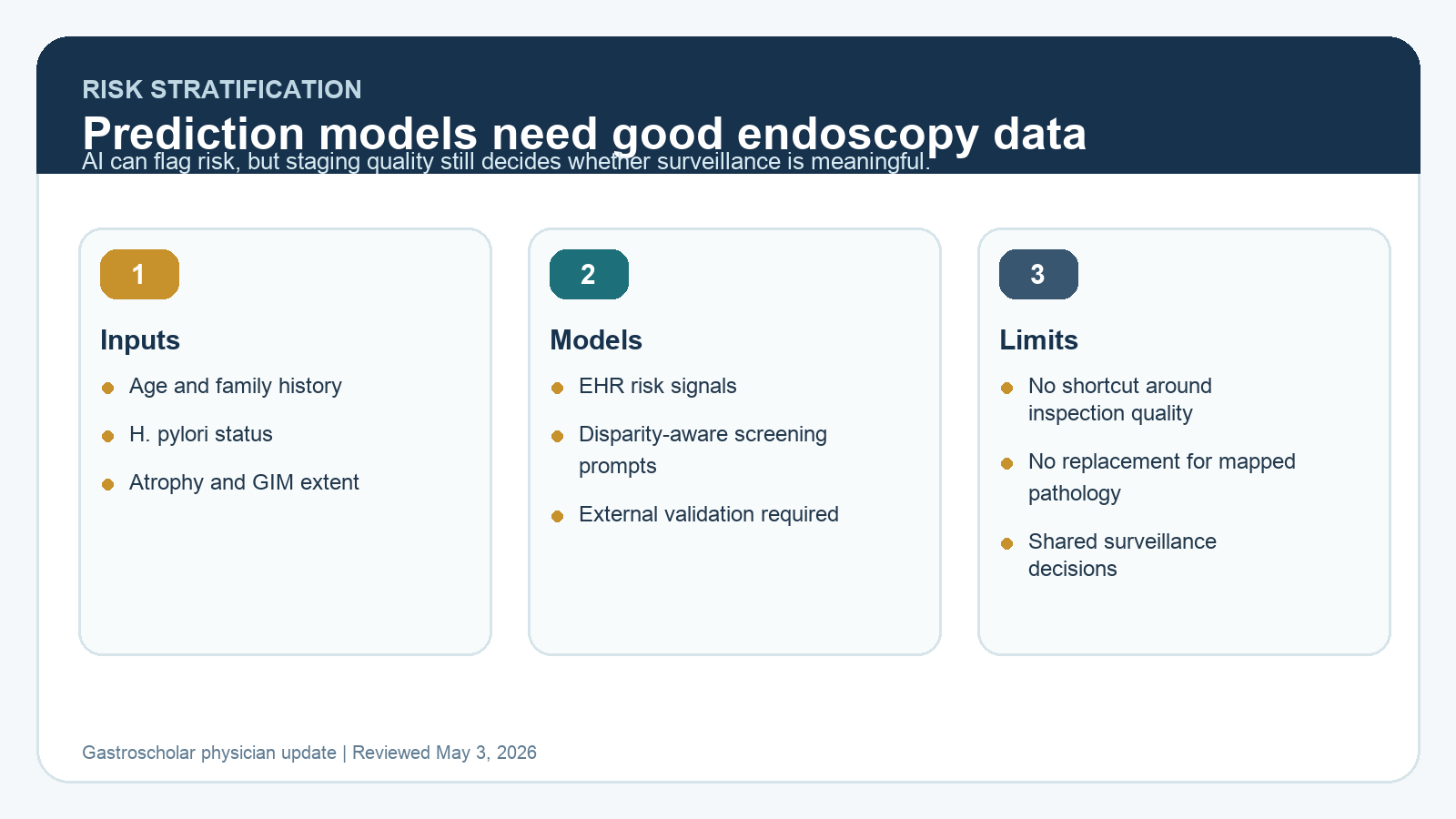
Electronic health record models and AI-assisted risk tools may help identify patients who deserve gastric cancer screening consideration, but they cannot replace high-quality endoscopy, mapped pathology, H. pylori eradication, or shared surveillance decisions. In 2026, the best use of prediction models is to reduce missed high-risk patients, not to automate surveillance intervals without clinical review.
| Input | Useful Signal | Limit |
|---|---|---|
| Clinical history | Family history, hereditary syndromes, smoking, autoimmune gastritis, pernicious anemia, and prior H. pylori. | Incomplete records can understate risk. |
| Pathology | Extent of atrophy or GIM, dysplasia, incomplete-type IM when reported, and OLGA or OLGIM staging. | Only as good as biopsy mapping and specimen labeling. |
| EHR models | Can flag patterns across age, diagnoses, labs, demographics, and prior utilization. | Need validation, calibration, and equity review before driving care. |
| Endoscopic quality | High-definition inspection and image enhancement can find subtle lesions and stage mucosa. | No prediction model fixes a rushed or poorly documented exam. |
What Changed
Recent U.S. guidance has made gastric cancer prevention more actionable, while prediction research has raised an important operational question: can we find high-risk patients earlier using data already sitting in the chart? The answer is probably yes in selected systems, but the implementation has to be sober. A model can suggest who may need evaluation. It does not determine whether a specific gastric lesion is dysplastic, whether the stomach was adequately inspected, or whether surveillance remains appropriate for a particular patient.
What Models Can Help With
EHR-based models are attractive because U.S. gastric cancer screening is not population-wide. A clinic may have thousands of patients with risk factors spread across notes, demographics, lab patterns, diagnoses, and prior pathology. A model can help surface patients with noncardia gastric cancer risk signals, especially where disparities and fragmented care make manual identification unreliable.
That use case is different from automatic interval assignment. Before a model changes care, the practice needs to know how it was trained, whether it performs in the local population, whether it worsens or reduces disparities, and how false positives and false negatives will be handled. The output should trigger clinician review, not bypass it.
What Still Belongs to the Endoscopist
The endoscopist controls the highest-yield data: careful gastric inspection, lesion recognition, image enhancement, targeted biopsies, and mapping biopsies for staging. If the baseline EGD did not clean the stomach, fully inspect the mucosa, photograph key landmarks, or label specimens by location, downstream risk models are built on weak inputs.
Pathology also has to be usable. A report that separates focal antral GIM from extensive corpus-involving GIM changes the surveillance conversation. Dysplasia changes it even more. Autoimmune gastritis, incomplete-type intestinal metaplasia, and persistent H. pylori should not disappear into generic “chronic gastritis” language.
How To Apply This In Practice
- Use EHR risk tools as prompts for review, not as independent decision-makers.
- Build a structured intake field for family history, country or region of early life, prior H. pylori, autoimmune gastritis, and known GIM.
- Make gastric mapping biopsy templates easy to order and easy for pathology to interpret.
- Audit whether high-risk patients actually complete the recommended EGD or surveillance exam.
- Before adopting an AI model, ask for local performance, calibration, equity impact, and the workflow for follow-up.
Selected Sources
- AGA best practice advice summary for gastric cancer prevention
- PubMed: ACG Clinical Guideline on Gastric Premalignant Conditions
Clinical update for gastroenterologists and endoscopists. Reviewed May 2026.
