
Key Takeaways
- Clinical Bottom Line
- What Changed in the Last 12 Months
- Functional Cure: Definition and Reality
- Current Treatment Framework
Clinical Bottom Line
| Question | Current Answer | Practice Move |
|---|---|---|
| Has functional cure arrived? | No. HBsAg loss is the right endpoint, but it remains uncommon with approved therapy. | Keep nucleos(t)ide analog therapy as the clinical backbone when treatment is indicated. |
| What changed in 2025? | EASL reframed HBV care around broader risk assessment, better diagnosis, HCC prevention, and future finite therapy. | Reassess HBV DNA, ALT, fibrosis stage, HBeAg status, quantitative HBsAg when available, and HCC risk. |
| Where do siRNA and ASO agents fit? | They are promising investigational tools, not routine clinic drugs. | Discuss trial referral for appropriate patients, especially those interested in finite therapy strategies. |
What Changed in the Last 12 Months
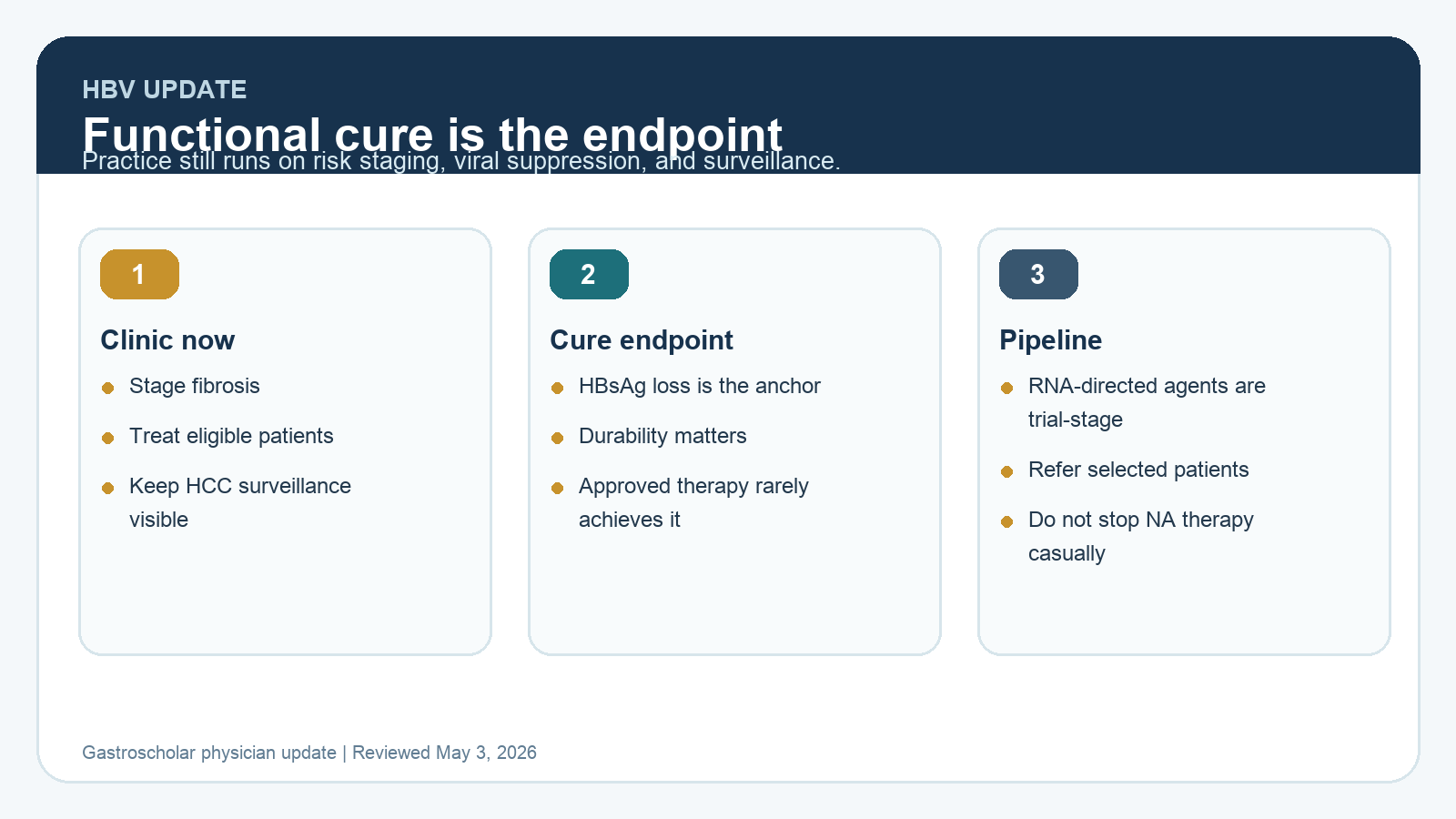
The 2025 EASL hepatitis B guideline is the key recent update. It keeps chronic HBV management grounded in viral suppression, fibrosis staging, HCC prevention, and special-population risk, while explicitly treating HBsAg loss as the desired functional cure endpoint.
The important practical point is restraint. Functional cure is the direction of travel, but current clinic care still depends on deciding who needs antiviral therapy now, maintaining adherence, monitoring for fibrosis and HCC, and recognizing when a patient belongs in a clinical trial rather than in a premature finite-therapy plan.
Functional Cure: Definition and Reality
Functional cure generally means sustained HBsAg loss with durable suppression of HBV DNA after finite therapy. Some trials also track anti-HBs seroconversion, HBcrAg, HBV RNA, or other emerging biomarkers, but HBsAg loss remains the clean clinical anchor.
Approved therapies rarely achieve that endpoint. Long-term nucleos(t)ide analog therapy suppresses HBV DNA and lowers clinical risk, but HBsAg loss is uncommon. Pegylated interferon can produce finite-treatment responses in selected patients, but tolerability and patient selection limit broad use.
Current Treatment Framework
Who should be treated now
Most treatment decisions still start with HBV DNA, ALT, fibrosis stage, cirrhosis status, age, HBeAg status, family history, extrahepatic manifestations, and anticipated immunosuppression.
- Treat HBeAg-positive or HBeAg-negative chronic hepatitis B when HBV DNA is elevated and ALT is above the upper limit of normal, especially with significant fibrosis.
- Treat patients with advanced fibrosis or cirrhosis when HBV DNA is detectable, even if ALT is not striking.
- Plan prophylaxis before immunosuppression using HBsAg, anti-HBc, and HBV DNA status.
- Do not let a normal ALT alone create false reassurance when fibrosis, age, family history, or HCC risk changes the risk profile.
Which drugs still anchor practice
Entecavir, tenofovir disoproxil fumarate, and tenofovir alafenamide remain the usual high-barrier oral agents. Drug selection depends on renal function, bone health, prior resistance, pregnancy considerations, comorbidities, cost, and local formulary access.
For a busy gastroenterology practice, the operational priority is not choosing a novel drug too early. It is finding untreated eligible patients, preventing reactivation, improving adherence, and making HCC surveillance hard to miss.
Novel Therapies to Watch
RNA-directed therapies, including antisense oligonucleotides and siRNA agents, aim to reduce viral antigen production. Bepirovirsen and other investigational agents have shown meaningful HBsAg reductions in subsets of patients, especially in combination strategies, but relapse, safety, durability, and patient selection remain unresolved.
For practice today, the right language is: trial-stage, promising, not standard of care. Patients who ask about cure should hear that finite therapy is an active research goal, but they should not stop effective nucleos(t)ide analog therapy outside a structured plan.
How to Apply This in Clinic
Initial or re-entry visit
- Confirm HBsAg, anti-HBc, anti-HBs, HBeAg, anti-HBe, HBV DNA, ALT, AST, platelets, albumin, bilirubin, INR when relevant, and coinfection status.
- Stage fibrosis with elastography or another validated method, and review prior biopsy only if it changes the decision.
- Assess HCC surveillance need based on cirrhosis, age, sex, ancestry, family history, and guideline-specific risk categories.
- Document pregnancy plans, renal disease, osteoporosis risk, HIV status, HCV or HDV coinfection, and immunosuppression exposure.
Follow-up visit
- For treated patients, track HBV DNA suppression, ALT normalization, adherence, renal and bone safety when tenofovir disoproxil fumarate is used, and HCC surveillance completion.
- For untreated patients, define the monitoring interval instead of leaving “inactive carrier” as a static label.
- Use quantitative HBsAg when it will change counseling, trial referral, or finite-therapy discussion.
- Avoid nucleos(t)ide analog discontinuation in cirrhosis. In non-cirrhotic selected patients, stopping therapy requires a written monitoring plan and rapid re-treatment threshold.
Practice Pitfalls
- Calling siRNA or ASO therapy a cure before phase 3 durability and approval data support that language.
- Stopping oral antiviral therapy because HBV DNA is suppressed without checking HBsAg, fibrosis stage, and follow-up reliability.
- Forgetting HCC surveillance in patients whose viral load is controlled but baseline risk remains high.
- Using ALT alone to decide risk in older patients or patients with advanced fibrosis.
- Missing HBV reactivation risk before biologics, chemotherapy, high-dose steroids, anti-CD20 therapy, or transplantation.
Key Sources
- EASL Clinical Practice Guidelines on HBV infection, 2025
- EASL HBV guideline PubMed record
- 2025 systematic review and meta-analysis on HBV functional cure with new antiviral therapy
- Sequential Peg-IFN after bepirovirsen phase 2b study, Journal of Hepatology 2025
Clinical guidelines summarized by the Gastroscholar Research Team. Last updated: May 3, 2026. This article is intended for physicians and advanced clinicians.
