GI Endoscopy · 10 min read
Colon Ischemia in 2026: Watershed Injury, Isolated Right Colon, When to Operate
Cramp, urge, then blood is ordinary colon ischemia. Pain without blood is not. CTA the SMA when the right colon is the only segment, then decide about the scope.
Colon ischemia is a sudden drop in colonic perfusion, usually without a lasting arterial occlusion. The common story is left-sided cramp, an urge to defecate, and blood within 24 hours. Most of those patients recover with fluids. Isolated right-colon ischemia is a different disease: get multiphasic CTA, because the superior mesenteric artery may be next. Do not colonoscope peritonitis, pneumatosis, or free air.
Experienced teaching points
Clinical Pearls
- Pain, then blood, then a segmental left colon: that is colon ischemia until the biopsies say otherwise. Pain without blood is isolated right-colon ischemia or acute mesenteric ischemia until CTA says otherwise.
- Do not put a colonoscope into peritonitis, pneumatosis, or free air. Those patients need a surgeon, not an insufflator.
- Stop at the distal edge of disease. Carbon dioxide, low pressure. Biopsy unless the mucosa is already black.
- Isolated right-colon ischemia had a 30-day mortality around 20% and surgery in about half of Brandt's and Sotiriadis's series. Treat it as a mesenteric warning, not as ordinary left-sided colitis.
- Most left-sided colon ischemia gets better with bowel rest and volume. Do not take that bet on gangrene, shock, pancolitis, or a silent right colon.
Clinical Bottom Line
| Question | 2026 practical answer |
|---|---|
| What is colon ischemia? | ACG 2015 prefers this name over ischemic colitis. Sudden hypoperfusion of colon mucosa, usually nonocclusive. The left colon is the usual map. See Griffith's point and Sudeck's point for the watershed anatomy. |
| Classic story | Sudden mild or moderate cramp, an urgent need to defecate, then bright red or maroon stool within 24 hours. All three in that order in about half of patients (Montoro, Longstreth). |
| How is this not AMI? | Acute mesenteric ischemia is pain out of proportion, usually without early bleeding. CTA first, not colonoscopy. Full differentiator: AMI vs colon ischemia. |
| First imaging | CT abdomen and pelvis with IV contrast for suspected colon ischemia (ACG strong). Multiphasic CTA if isolated right-colon ischemia, or if you cannot exclude AMI (ACG strong). |
| Colonoscopy | Within 48 hours if there is no peritonitis and no radiographic infarction (ACG strong). Stop at the distal-most diseased segment. Minimal insufflation, carbon dioxide when you have it. Biopsy unless gangrene. |
| Isolated right colon | Worse: surgery in about half, 30-day mortality around 20% (Sotiriadis 2007, Brandt 2010). Pain often without bleeding. CTA the SMA before discharge. This can be the warning shot for mesenteric occlusion. |
| Antibiotics | Consider for moderate or severe disease (ACG strong, very-low evidence). Not a substitute for source control if the bowel is dead. |
| Operate when | Peritonitis, gangrene, pneumatosis with portal gas in this clinical setting, shock, unremitting hemorrhage, or failure of supportive care. Also take IRCI and pancolonic disease seriously even before the abdomen boards (ACG strong). |
| After it settles | Most patients do not need a proof-of-healing colonoscopy. If they have not been screened recently, complete the colon weeks later to look for a distal obstructing cancer. Recurrence is about 1 in 10. |
What is colon ischemia?
ACG 2015 asked us to say colon ischemia, not ischemic colitis, because the injury is not always inflammatory. The pathophysiology is a transient drop in mucosal flow. By the time the patient is in front of you, flow has often already returned. What you see is reperfusion: edema, hemorrhage, a stripe of ulcer, sometimes a stricture later. That is why a dedicated mesenteric angiogram is the wrong first test for ordinary left-sided disease. There is usually nothing left to stent.
The left colon is the most common map (about a third of Brandt's 313 biopsy-proven cases). Distal colon and right colon each take about a quarter. Pancolitis is uncommon and behaves badly. The rectum is often spared because the middle and inferior rectal arteries come off the iliacs, not the IMA. Watershed teaching is still useful: the splenic flexure is Griffith's point, the rectosigmoid is Sudeck's point. Hypotensive, nonocclusive injury prefers Griffith. Iatrogenic IMA ligation prefers Sudeck. Do not treat those two pages as the same disease.
Risk is age, atherosclerotic burden, dialysis, COPD, constipation, IBS history, vasoconstrictors, constipation-inducing drugs, cocaine, and a recent AAA repair. Young patients and recurrences deserve a thrombophilia look. ACG does not want a clotting panel on every 78-year-old with a one-off left-sided episode.
How do I tell this from acute mesenteric ischemia?
Wrong label, wrong clock. AMI is a small-bowel arterial (or venous) emergency. Colon ischemia is usually a colon mucosal injury that has already happened. The bedside split:
- Colon ischemia: cramp, urge, blood. The abdomen is uncomfortable, not board-like, unless it has progressed.
- AMI: pain out of proportion to the exam. Bleeding is late. Lactate and peritoneal signs mean you are already behind.
If the story is mixed, or the CT shows only the right colon, do not talk yourself into ordinary colitis. Get CTA. The overlap page is AMI vs colon ischemia.
When do I get CT versus colonoscopy?
CT with IV contrast is the first picture in the emergency department (ACG strong). It suggests the diagnosis (segmental wall thickening, thumbprinting, fat stranding), maps the segment, and looks for pneumatosis, portal gas, and free air. It is not specific. Diverticulitis, infection, and IBD share the same CT language.
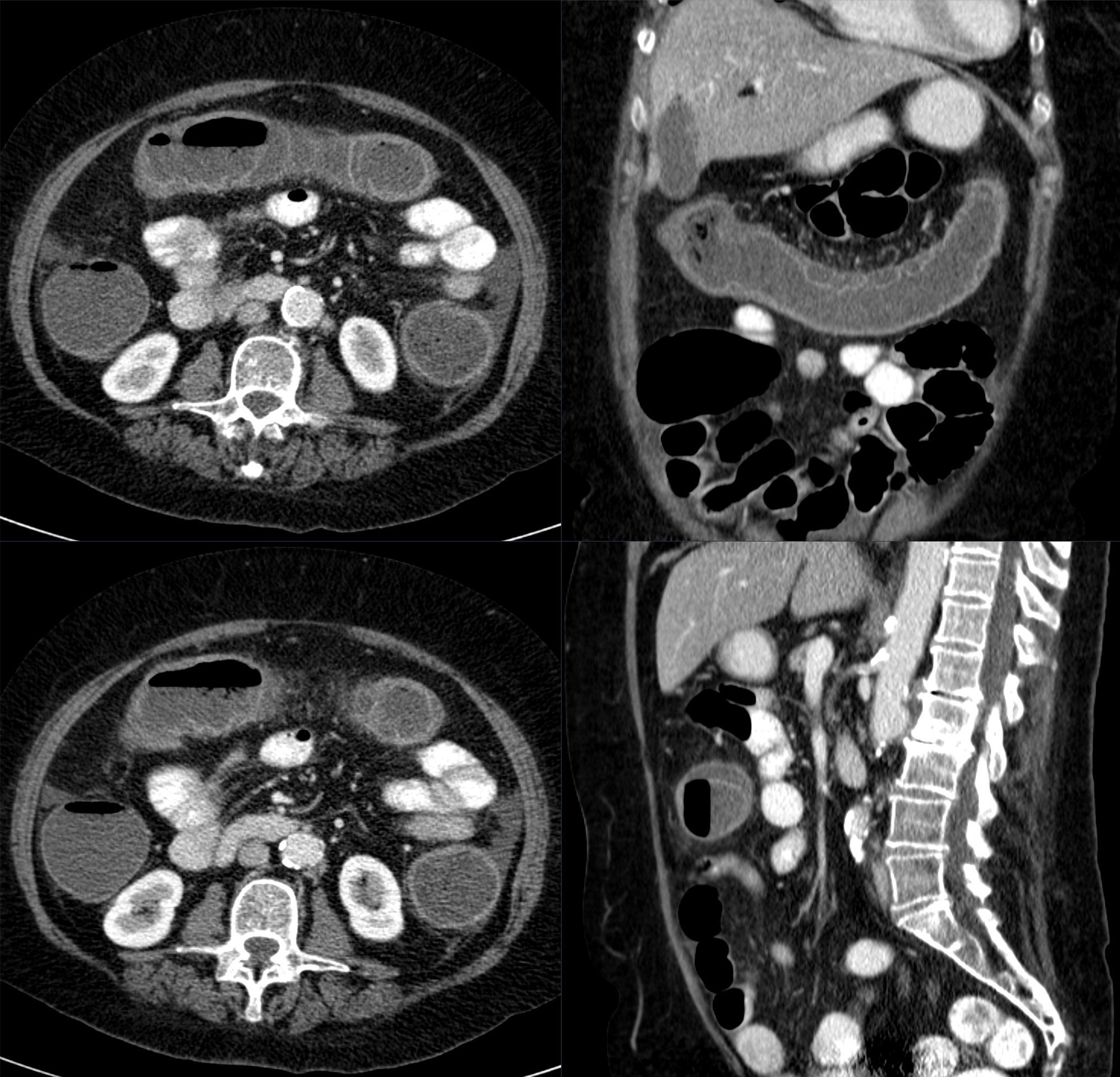

Multiphasic CTA is not for every left-sided bleeder. It is for isolated right-colon ischemia, for pain without bleeding, for atrial fibrillation with a scary abdomen, and for any case where AMI is still on the list (ACG strong). If that CTA is negative and the story still sounds like SMA disease, conventional angiography is reasonable (ACG conditional).
Colonoscopy confirms mucosa and gets tissue. Do it within 48 hours. Montoro's hemorrhagic nodules were visible in 47% of exams in the first 48 hours, 33% at days 2 to 5, and 10% after day 5. Wait a week and you will talk yourself out of the diagnosis.
Do not scope peritonitis or radiographic infarction (ACG strong). In severe disease, use CT to map the segment and do a limited exam to the distal edge only. Boley's old physiology still applies: 30 to 60 mm Hg of air steals mucosal flow. Carbon dioxide raises colonic flow in the lab compared with room air. Use it.
What should I do on the scope?
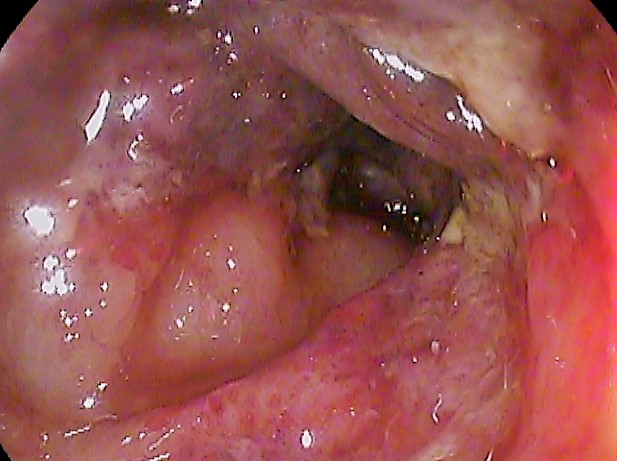
The picture is segmental, with a sharp line between injured and intact mucosa. Common findings in Montoro's colonoscopy cohort: erythema, edema, friability, superficial ulcer including the single-stripe sign, and less often deep ulcer, stenosis, or blue-black mucosa.
The colon single-stripe sign (Zuckerman) is a longitudinal band of erythema, erosion, or ulcer, usually left-sided, usually longer than 5 cm. In that small series it predicted a milder course than circumferential disease. It is not a reason to skip clinical judgment. Purple, boggy mucosa can still recover. Black mucosa is gangrene. Abort, call surgery, do not biopsy necrosis.
Biopsy the involved segment when it is not gangrenous (ACG strong). Ghost cells and frank infarction are uncommon on endoscopic bites. Hemorrhage, edema, capillary fibrin thrombi, and neutrophils are the usual support, not a courtroom diagnosis by themselves. The note should say colon ischemia in the clinical context, not "nonspecific colitis, follow up."
Favier's three endoscopic stages are still taught in some rooms. ACG does not use them to triage. Clinical severity does. Do not let a pale, ugly left colon talk you into a colectomy if the patient is eating ice chips and making urine. Do not let a deceptively pink right colon talk you out of CTA.
Why does isolated right-colon ischemia matter?
IRCI is the sentence that should change the next test. Sotiriadis (273 biopsy-proven cases): 30-day mortality 22.5% vs 11.9%, surgery 54.9% vs 10.9%. Brandt 2010: 20.3% vs 9.0% 30-day mortality. Pancolonic disease is in the same bucket. Longstreth found that IRCI or bilateral disease carried a large hazard for surgery or death.
The story is often pain without hematochezia. Atrial fibrillation, coronary disease, and dialysis are over-represented. The SMA supplies the right colon and the small bowel. A right-colon insult can be the first public appearance of an SMA thrombus. ACG wants CTA in every IRCI, on the way in or before discharge. A negative triple-phase study does not make angiography illegal if the story is still wrong.
This is also why you do not send IRCI home on a "self-limited colitis" script.
Who needs antibiotics or an operation?
ACG's working split:
- Mild. Typical symptoms, no predictors of severity. Supportive care. Many of these patients never needed a hospital bed.
- Moderate. Up to three predictors (male sex, hypotension, tachycardia, pain without bleeding, BUN over 28 mg/dL, hemoglobin under 12 g/dL, LDH over 450 U/L, sodium under 136, WBC over 15, or ulceration on the scope). Admit. Volume. Consider antibiotics. Watch.
- Severe. More than three predictors, or peritoneal signs, IRCI, pancolonic disease, or gangrene. Antibiotics. Surgical consult. ICU thinking.
Most cases resolve without a specific drug (ACG strong). Antibiotics are a consideration in moderate and severe disease (ACG strong, very-low evidence), aimed at translocation across broken mucosa, not at a named pathogen. They are not a delay tactic for dead bowel.
Operate for peritonitis, gangrene, shock that does not reverse, massive ongoing bleeding, or failure of medical care. ACG also wants you to think about an operation in IRCI, pancolonic disease, and the combination of hypotension, tachycardia, and pain without bleeding. The resection is a segmental colectomy. Primary anastomosis in clearly ischemic tissue is how leaks are born. A stoma is not a failure.
Do not anticoagulate ordinary left-sided colon ischemia. Anticoagulate mesenteric venous thrombosis and treat embolus or in-situ SMA thrombosis as AMI, not as colitis. Wean vasoconstrictors. Stop the constipation cocktail. Steroids are not therapy.
What happens after the colon heals?
If the patient becomes asymptomatic, ACG does not ask for a routine proof-of-healing colonoscopy. If they have not been screened recently, complete the colon several weeks later. Colon ischemia can sit proximal to an obstructing cancer, stricture, or fecaloma. Do not do that screening exam on day 1. Distention is the enemy of a recently ischemic mucosa.
Stricture and chronic colitis are the uncommon tails. Recurrence is on the order of 10%. A second episode in a young patient is when the thrombophilia workup earns its keep. Cardiac source hunting is selective: do it when embolus is plausible, not as a reflex echocardiogram on every left-sided bleed.
Selected references
- Brandt LJ, Feuerstadt P, Longstreth GF, Boley SJ. ACG Clinical Guideline: Epidemiology, Risk Factors, Patterns of Presentation, Diagnosis, and Management of Colon Ischemia (CI). Am J Gastroenterol. 2015;110:18-44.
- Brandt LJ, Feuerstadt P, Blaszka MC. Anatomic patterns, patient characteristics, and clinical outcomes in ischemic colitis: a study of 313 cases supported by histology. Am J Gastroenterol. 2010;105:2245-2252.
- Sotiriadis J, Brandt LJ, Behin DS, Southern WN. Ischemic colitis has a worse prognosis when isolated to the right side of the colon. Am J Gastroenterol. 2007;102:2247-2252.
- Longstreth GF, Yao JF. Epidemiology, clinical features, high-risk factors, and outcome of acute large bowel ischemia. Clin Gastroenterol Hepatol. 2009;7:1075-1080.e1-2.
- Montoro MA, Brandt LJ, Santolaria S, et al. Clinical patterns and outcomes of ischaemic colitis: results of the Working Group for the Study of Ischaemic Colitis in Spain (CIE study). Scand J Gastroenterol. 2011;46:236-246.
- Feuerstadt P, Aroniadis O, Brandt LJ. Features and outcomes of patients with ischemia isolated to the right side of the colon when accompanied or followed by acute mesenteric ischemia. Clin Gastroenterol Hepatol. 2015;13:1962-1968.
- Zuckerman GR, Prakash C, Merriman RB, Sawhney MS, et al. The colon single-stripe sign and its relationship to ischemic colitis. Am J Gastroenterol. 2003;98:2018-2022.
- Hung A, Calderbank T, Samaan MA, Plumb AA, Webster G. Ischaemic colitis: practical challenges and evidence-based recommendations for management. Frontline Gastroenterol. 2021;12:44-52.
Last reviewed September 20, 2026. Written for clinicians triaging bloody diarrhea versus pain out of proportion, and deciding who can be watched and who needs an operating room.
Topics
For your teaching file
Save this article as a PDF
Drop your email and we'll open a print-ready version you can save as a PDF — and you'll start getting our weekly GI endoscopy newsletter.