
Key Takeaways
- Clinical Bottom Line
- What Changed in the Last 12 Months
- The Decision Framework
- What to Tell the Patient
Clinical Bottom Line
| Question | Current Answer | Practice Move |
|---|---|---|
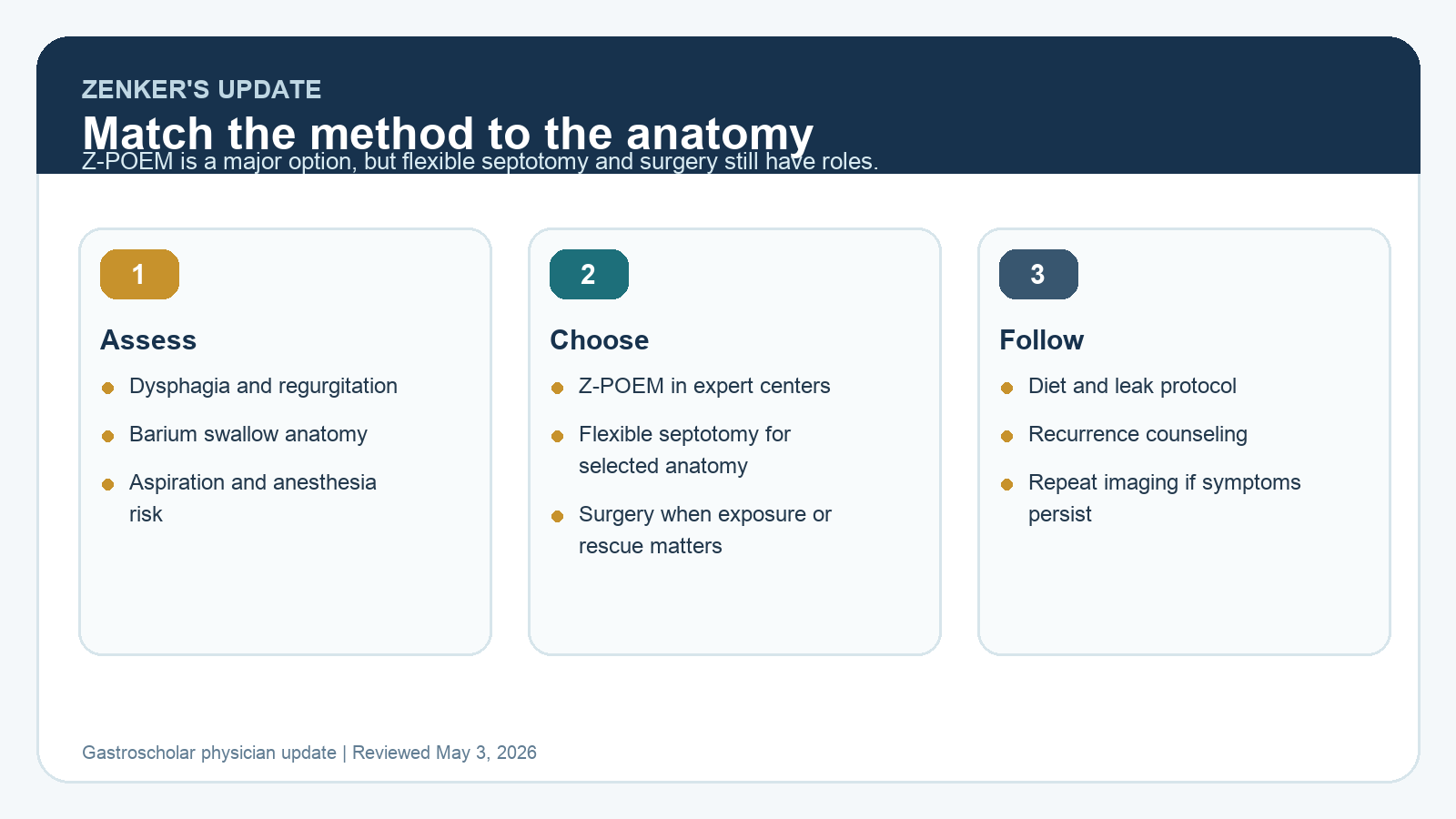
| Is Z-POEM now the default? | It is a major option in expert centers, with high clinical success in modern series, but it is not the only reasonable approach. | Match treatment to pouch size, septum length, local expertise, anesthesia risk, and prior therapy. |
| Where does flexible septotomy still fit? | It remains useful, especially when rapid septal division is appropriate and the center has reliable experience. | Avoid framing Z-POEM and flexible septotomy as a simple winner-take-all choice. |
| When should surgery remain on the table? | Open or rigid approaches can still matter for anatomy, exposure limits, failed endoscopic therapy, or local expertise gaps. | Discuss the case with ENT or surgery early when neck mobility, aspiration risk, or anatomy makes endoscopy less straightforward. |
What Changed in the Last 12 Months
The recent Zenker’s literature is less about proving that endoscopy works and more about refining which endoscopic approach fits which patient. Z-POEM has accumulated enough multicenter and review-level experience to be considered a durable third-space option in centers that perform it regularly.
The practical update is nuance. The older public-facing claim that open surgery is essentially obsolete is too strong. A busy endoscopist should think in terms of anatomy, exposure, procedure time, closure reliability, complication rescue, and recurrence risk.
The Decision Framework
Start with anatomy and symptoms
Zenker’s diverticulum is clinically relevant when the cricopharyngeal septum produces dysphagia, regurgitation, aspiration, cough, halitosis, weight loss, or repeated food retention. Small incidental pouches and vague throat symptoms need a careful swallow history before anyone reaches for a knife.
- Confirm the diagnosis with barium esophagram or videofluoroscopic swallow study when the anatomy is uncertain.
- Use endoscopy carefully. The pouch can be entered unintentionally, and retained food increases aspiration risk.
- Assess pouch size, septum length, neck extension, dentition, aspiration history, anticoagulation, and anesthesia risk.
Choose the procedure by what must be divided
The therapeutic target is the cricopharyngeal septum. Flexible septotomy divides the septum directly. Z-POEM uses a submucosal tunnel to expose and divide the muscle while preserving a mucosal entry site that is closed at the end of the case.
Z-POEM can help when complete myotomy is the priority, especially for larger symptomatic pouches or recurrent symptoms after prior septotomy. Flexible septotomy can be efficient for selected anatomy and remains familiar in many advanced endoscopy units.
What to Tell the Patient
- The goal is symptom relief, especially dysphagia and regurgitation, by dividing the obstructing cricopharyngeal septum.
- Most modern endoscopic approaches are minimally invasive, but they are not risk-free. Bleeding, perforation, leak, mediastinitis, aspiration, and recurrence still belong in consent.
- Recurrence can happen because the septum was incompletely divided, the pouch anatomy is complex, or fibrosis limits the effect of repeat therapy.
- Post-procedure diet and observation vary by center. The key is having a clear protocol for leak concern, fever, chest pain, aspiration, or worsening dysphagia.
Where Z-POEM Is Strongest
Z-POEM is attractive when the endoscopist wants controlled submucosal access, complete septal myotomy, and reliable closure. Recent reviews report high clinical success and generally favorable safety in experienced hands, while also describing technical modifications such as no-knife or open-style approaches.
The main limitation is not just equipment. It is system readiness. Z-POEM requires third-space skill, anesthesia support, closure tools, fluoroscopic or surgical backup as needed, and a team that recognizes early complications.
Practice Pitfalls
- Calling open surgery obsolete. It is less common for many patients, but it remains relevant in selected cases.
- Proceeding without reviewing swallow imaging when the pouch anatomy is unclear.
- Underestimating aspiration risk in patients with retained pouch contents.
- Using Z-POEM in a center without a mature third-space endoscopy workflow.
- Failing to set expectations that symptom recurrence can require repeat intervention.
How to Apply This in Practice
- Create a Zenker’s intake template: dominant symptom, aspiration history, weight loss, pouch size, septum length, prior therapy, antithrombotics, anesthesia risk, and neck mobility.
- Route straightforward symptomatic cases to the local team with the best measured outcomes, not to the newest technique by default.
- For recurrent Zenker’s after septotomy, ask whether residual septum, scar, or anatomy makes Z-POEM the cleaner rescue strategy.
- For frail patients, make the first question procedural tolerance, not technical elegance.
Key Sources
- 2026 review of Z-POEM technical advances, outcomes, and complications
- 2025 comprehensive review of Zenker’s diverticulum management strategies
- Prospective comparison of Z-POEM with flexible endoscopic septotomy and 2-year follow-up
- 2025 study of fluoroscopic and clinical outcomes after modern Z-POEM
- 2025 report of open Z-POEM technical and clinical outcomes
Clinical guidelines summarized by the Gastroscholar Research Team. Last updated: May 3, 2026. This article is intended for physicians and advanced clinicians.
